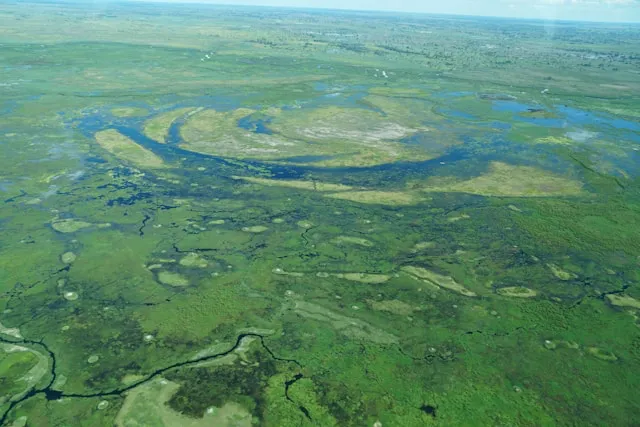
Honest first: most of the Okavango Delta is not self-drive country. The famous fly-in lodges, the deep papyrus waterways, the mokoro channels — you reach those by light aircraft or traditional boat, not by 4x4. There is one exception, and it is significant: Moremi Game Reserve, which protects roughly a third of the Delta ecosystem on its eastern and central side, can be entered with your own vehicle. If you are self-driving, Moremi is your Okavango Delta. This guide is about doing it properly.
Moremi Game Reserve was established in 1963 by the BaTawana people — the first wildlife reserve in Africa created by a local community on their own traditional lands. It is the only formally protected part of the Delta open to road access, and the parts you can drive include the Mopane Tongue (the higher ground where dry land meets the main channels), Third Bridge, Xakanaxa, and the Khwai area just outside the northern boundary.
What you cannot drive: Chief's Island (deep in the central Delta, predator-rich, reached only by light aircraft to the airstrips at the luxury lodges), the panhandle in the north-west, and almost all of the wider Delta waterways. If those are the experiences you want, you are flying in. Self-drive Moremi is a different trip — harder, longer, more adventurous — and worth understanding on its own terms rather than as a budget version of a fly-in safari.
Moremi has two main gates, both reached only by 4x4 access roads:
South Gate (Maqwee Gate) — the
standard entry, about 2 hours' drive from Maun. From Maun
north on the tar road to Shorobe (40 km tarred), then 52 km
of dirt road to the gate. Most self-drive itineraries start
here.
North Gate (Khwai) — on the northern
boundary of the reserve, used by self-drivers continuing on
to or arriving from Chobe and Savuti. Entering at North Gate
from the Khwai side involves a river crossing that is usually
straightforward but can be treacherous when water levels are
high.
The classic self-drive route through the reserve goes Maun → South Gate → Third Bridge → Xakanaxa → North Gate (Khwai), and from Khwai you either turn around or continue north to Savuti and Chobe. Allow at least four nights inside the reserve to do it justice; longer if you can.
This is the single most important practical fact about self-driving Moremi: the four public campsites are often fully booked, especially in peak dry season (June–October), and you cannot just turn up. Self-drive Moremi without a campsite booking is not viable — there is no overflow, no nearby town, and no permission to wild-camp inside the reserve. Three different private operators run the four campsites, which adds a quirk you should know about:
South Gate Camp and Xakanaxa
Camp are operated by Kwalate Safaris.
Third Bridge Camp is operated by Xomae
Group.
North Gate (Khwai) Camp is operated by SKL
Camps.
The standard 4-to-5-night itinerary. Enter at South Gate, spend a night there easing into the rhythm, then push northwest to Third Bridge via the meandering track that crosses First and Second Bridges (rickety mopane-log constructions, easy to cross unless water is high). Two nights at Third Bridge, on the edge of the Delta proper with Mboma Island and the Sekiri River nearby. Then to Xakanaxa on the western waterways for boat trips into the heronry and lagoons, and finally up to Khwai at North Gate. The route is roughly 130 km but takes most of a week at game-viewing pace.
Often combined with self-drive Moremi as a softer landing. The Khwai community lands sit just north of Moremi's North Gate and allow night drives, which are not permitted anywhere inside Moremi itself. Wildlife crosses freely between the two areas. Booking is easier than for the public campsites inside the reserve.
The bigger expedition: Maun → Moremi (South Gate, Third Bridge, Xakanaxa) → Khwai → Mababe Gate → Savuti → Linyanti → Chobe Riverfront → Kasane. The classic northern Botswana overland trip, roughly 600–700 km of mostly deep sand. For experienced sand drivers in fully equipped 4x4s, with all campsites booked months ahead.
Moremi is more variable than most parks. Water levels rise and fall with the annual Delta flood (peak around July–August), and what was a track last year may be a waterway this year. Phone ahead. The DWNP office in Maun, the campsite operators, and overlanding forums all give current information on which roads are passable. Recent self-drivers have reported bridges between the campsites being out of service in some years and tracks between Xakanaxa and Khwai closed during high-water months. Plan a route, then plan a backup.
Plan for no signal across most of the reserve. Of the Botswana carriers, Mascom has the widest safari coverage; Orange Botswana is reasonable in Maun town but weaker in the bush. Inside Moremi expect intermittent signal only near North Gate (Khwai) — one of the campsites is within sight of a cell tower — and effectively nothing across the rest of the reserve. Most lodges in the wider Delta now run Starlink satellite WiFi as the evening connectivity solution.
The technical point most travellers miss: your phone's GPS works without any signal or data. GPS is a one-way satellite signal your phone receives directly. The only thing that fails offline is the map — so the maps have to be stored on the device before you enter the park. This is precisely the gap SavannaQuest is built for: every Moremi map is pre-loaded, so positioning and route recording keep working with the phone in airplane mode across the reserve.
For Moremi more than any other park in our set, carry a proper paper map and supplement it with current local knowledge. The Tracks4Africa atlas or its GPS data is the long-standing gold standard for Botswana navigation. Stop at the DWNP office in Maun before you head north — they will tell you what is open and what is flooded. Treat any phone app as a position-and-route-recording companion, not a replacement for the paper map and never your single source of truth.
The dry season (May to October) is the strongest time, with the Delta flood paradoxically peaking in July and August — wildlife is concentrated, tracks are largely passable, and the contrast between flooded channels and dry surrounding bush is at its most dramatic. September and October are the peak game-viewing weeks but also the hardest for campsite bookings. The wet season (November to April) is cheaper and quieter but many tracks become impassable and the park can close to self-drive visitors entirely after heavy rains.
Can you self-drive in the Okavango Delta?
Only the Moremi Game Reserve portion of the Delta is self-drive accessible. The rest is fly-in or mokoro only. Moremi is significant enough to be its own destination — but be clear with yourself that you are not going to see the whole Delta by road.
Do you need a 4x4 in Moremi?
Absolutely. Deep sand, water crossings, and seasonal flooding make Moremi 4x4-only. Most international visitors hire fully equipped vehicles in Maun, Kasane, Windhoek or Johannesburg.
Which gate should I use?
South Gate from Maun for the standard entry. North Gate (Khwai) if you are continuing to or arriving from Chobe and Savuti.
Is there phone signal in Moremi?
Almost none. Intermittent near North Gate, nothing else. Mascom has the best Botswana coverage. GPS positioning still works without signal if your maps are downloaded in advance.